The derivatives market is a distinct domain even within the broader stock market.
Due to its high leverage and rapid volatility, it presents both opportunities and risks to many investors.
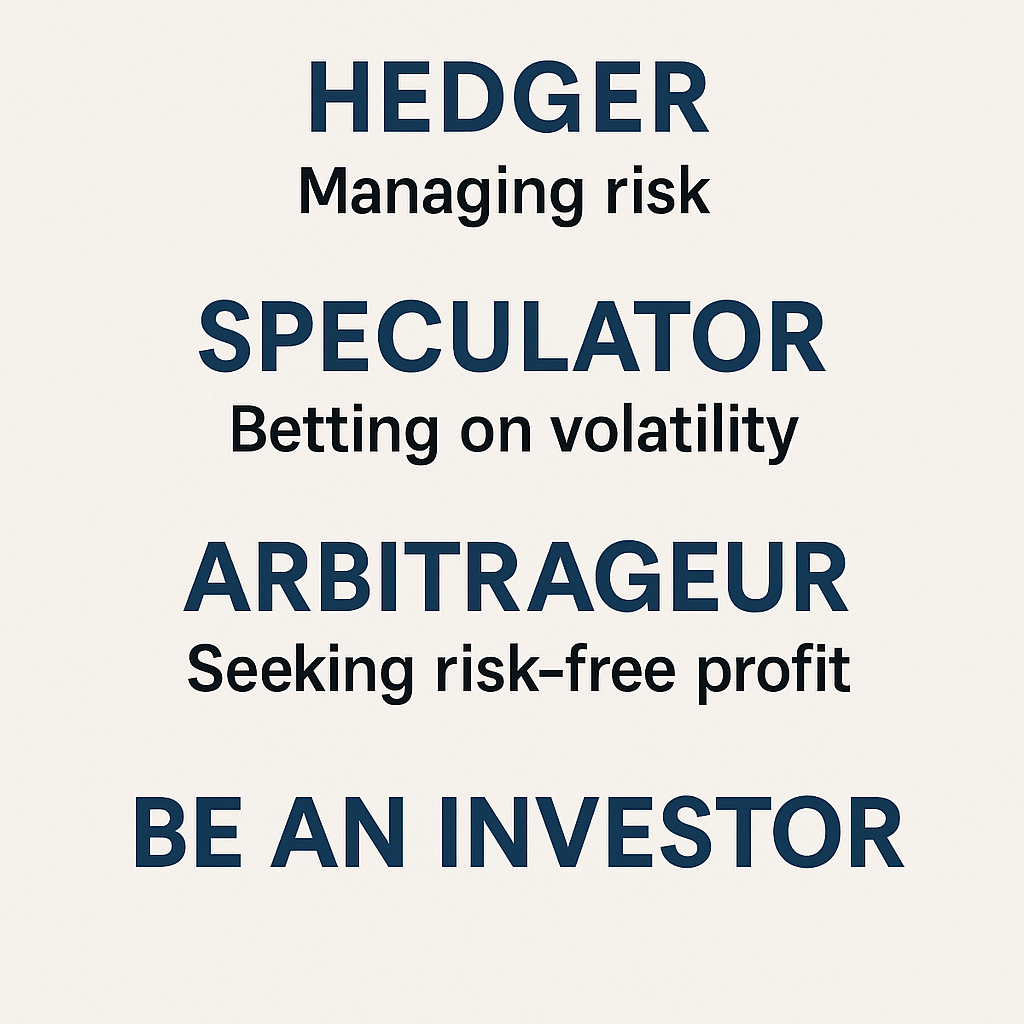
Participants in the derivatives market can generally be categorized into three types:
1. The Hedger — Managing Risk
Hedgers use derivatives primarily to mitigate risk.
For example, a company generating overseas revenue might enter into a forward contract to hedge against currency fluctuations.
Similarly, a farmer may take a short position in the futures market before harvest to protect against falling crop prices.
In both cases, the objective is not speculative gain but securing stability.
Whether stock prices rise or fall, or exchange rates shift, the goal is to shield the company’s core business — much like taking out insurance.
2. The Speculator — Betting on Volatility
Speculators are often seen as the heart of the derivatives market.
They actively leverage market volatility, betting on price movements in either direction to seek short-term profits.
A prime example is retail investors trading leveraged or inverse ETFs.
These products are designed to amplify daily index movements by two or three times, or move in the opposite direction.
This means investors can earn large profits in a single day — but losses can just as quickly compound.
Speculation is thrilling.
The rush of seeing profits instantly appear in your account is addictive, and many find themselves returning to speculative trades.
But in reality, very few consistently make substantial gains.
Speculators are inherently vulnerable to the very volatility they try to exploit.
3. The Arbitrageur — Seeking Risk-Free Gains
Arbitrageurs profit from price discrepancies between markets.
For instance, when there’s a gap between spot and futures prices, they simultaneously open long and short positions to lock in that spread.
Theoretically, this resembles a risk-free return, but real-world factors like trading fees, taxes, and liquidity challenges mean it’s not entirely without risk.
Still, unlike speculation, arbitrage tends to offer more stable, probability-based returns.
The Reality of Leveraged ETF Traders
Many retail investors are drawn to leveraged or inverse ETFs due to their accessibility.
While these can yield rapid profits when you correctly predict short-term index movements, their compounding structure often works against you over time, eroding principal.
The real problem is this: many mistake speculation for investing.
True investing is about value creation and long-term growth.
Leveraged products are, at best, short-term bets.
Conclusion: Be an Investor, Not a Gambler
There’s no denying the appeal of speculation.
The instant gratification and fast gains can feel like a casino.
But real wealth is built over the long term — and only along the path of the investor.
- The hedger protects their core business.
- The speculator chases excitement.
- The arbitrageur seeks opportunity in margins.
Of these three, it’s clear which one individual investors should aim to be.
Evaluating corporate value, following market trends, and growing assets steadily — this is the true investor’s path.
Big money doesn’t come from gambling.
Lasting wealth is born from real investment.
If you want to build wealth, be an investor — not a speculator.
 The Valuation : Value Investing Through Valuation
Leave a comment